


What Is Phase I, II, III, and IV? A Straightforward Guide to Clinical Trial Phases
Every new medicine or treatment goes through a series of steps before it becomes available to the public. Each step is called a "phase." There are four of them. They go in order, and each one has a different goal and a different group of participants.
Why Are There Phases at All?
Researchers don't test a new drug on thousands of people right away. They start small, ask careful questions, and only move forward if the results look good. Each phase builds on what was learned in the one before.
This process protects patients, and it's why you can trust that any drug your doctor prescribes has been through years of careful testing.
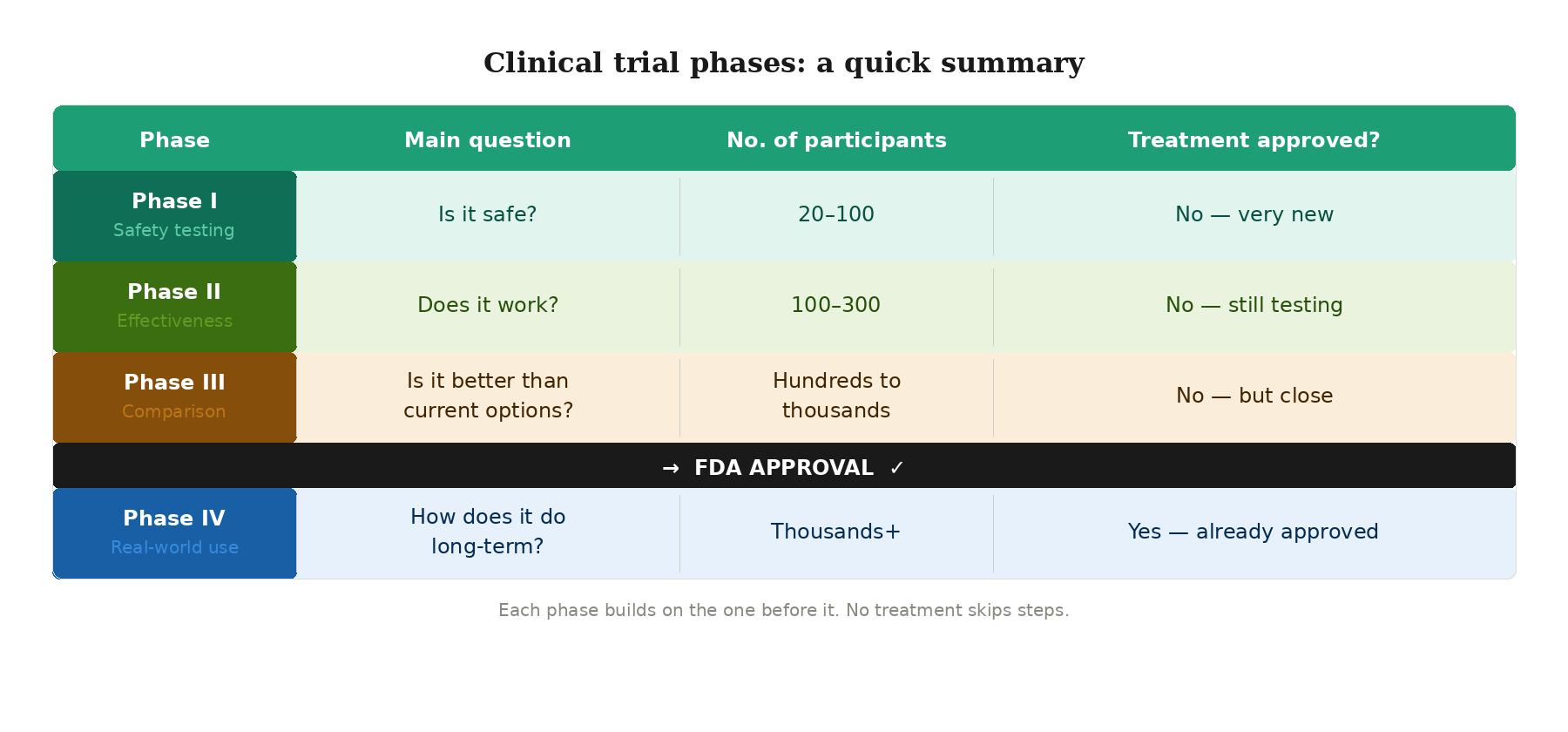
Phase I: Is It Safe?
The main question: Is this treatment safe for humans, and how much can people take?
Who participates: Usually 20–100 people. In most Phase I trials, these are healthy volunteers- people who don't have the disease being studied. In cancer research, Phase I trials often involve patients who have the disease and have already tried other treatments.
What happens: Participants receive the treatment, often starting at a very low dose. Researchers watch closely for side effects. They slowly increase the dose over time to find the highest amount that's safe to give.
How long it takes: A few months to about a year.
What participants experience: Frequent check-ins and monitoring. If it's an inpatient study, you may stay overnight at a clinic so researchers can keep a close eye on you. This phase typically involves the most hands-on monitoring of any phase.
Pay: Phase I trials tend to pay the most, often $1,000–$5,000 or more, because they require the most time and commitment, especially for healthy volunteers.
The bottom line: Phase I is about safety first. The treatment is very new, so there's more uncertainty. But researchers are watching extremely carefully.
Phase II: Does It Work?
The main question: Does this treatment actually do what we hope it does and is it still safe?
Who participates: Usually 100–300 people who have the condition the treatment is meant to help.
What happens: Now that researchers know the treatment seems safe (thanks to Phase I), they test it on people who actually have the disease. They're looking for early signs that it works. For example, does it reduce symptoms? Does it slow the disease? They also keep watching for side effects.
How long it takes: Several months to a few years.
What participants experience: Regular clinic visits, lab tests, and check-ins. You may receive the experimental treatment, or you may be in a comparison group that receives standard care.
The bottom line: Phase II is about effectiveness. Does this thing actually help? Many treatments don't make it past this phase, and that's the system working as intended.
Phase III: Is It Better Than What's Already Out There?
The main question: Is this treatment better or at least as good as the treatments doctors already use?
Who participates: Hundreds to thousands of people across many locations, often in multiple countries.
What happens: This is the big test. Researchers compare the new treatment directly to the current standard of care (whatever treatment most doctors already use). Half the group might get the new treatment. The other half gets the existing treatment or sometimes a placebo if no standard treatment exists. Nobody knows which group they're in until the study is over. This is called a "blinded" or "randomized" trial.
How long it takes: One to four years.
What participants experience: More visits over a longer period of time. The study is larger and more complex, but it also means more support from the research team. Participants in Phase III trials are often at the cutting edge testing treatments that may become the new standard of care.
The bottom line: Phase III is when a treatment earns its place. If results are strong, the company can apply to the FDA (the U.S. government agency that approves drugs) to make the treatment available to everyone.
This is the phase most people are thinking of when they hear "clinical trial."
FDA Approval: The Finish Line Between Phase III and Phase IV
After a successful Phase III trial, the company that makes the treatment submits all of its data to the FDA. Researchers and scientists at the FDA review everything- the safety data, the effectiveness data, how the treatment is made, and more.
If the FDA agrees the treatment is safe and effective, it gets approved. That means doctors can now prescribe it to patients.
This process usually takes 6 months to a couple of years after Phase III ends.
Phase IV: What Happens in the Real World?
The main question: How does this treatment perform when millions of people use it over many years?
Who participates: Large groups of people, sometimes tens of thousand, who are already using the approved treatment as part of their normal medical care.
What happens: Even after FDA approval, researchers keep studying the treatment. They want to know: Are there rare side effects that only show up when more people use it? Does it work as well in older adults or children? Are there long-term effects no one expected?
Phase IV studies are sometimes called post-market surveillance or post-approval studies.
What participants experience: Often less intensive than earlier phases. This might mean answering surveys, allowing access to your health records, or coming in for occasional check-ups. In many cases it closely resembles your normal medical routine.
The bottom line: Phase IV is about the long game. It helps make sure a treatment stays safe and effective as it reaches more and more people in the real world.So Which Phase Should You Join?
Which Phase is Best for You?
There's no single right answer. It depends on your situation, your health, and what you're hoping to get out of it.
Consider Phase I if:
You're a healthy volunteer and want to contribute to early research
You have a serious condition and have already tried other options
You're comfortable with more uncertainty and more frequent monitoring
The compensation matters to you (Phase I pays the most)
Consider Phase II or III if:
You have the condition being studied
You want a real chance at receiving a promising new treatment
You're okay with the possibility of being in a comparison group
You want to be part of a study with more data already behind it
Consider Phase IV if:
You're already taking an approved medication and want to contribute to ongoing research
You prefer lower-intensity participation
You want to help researchers understand long-term effects
In every case, the research team will screen you carefully to make sure the study is a good fit for your health situation. You won't be placed in a phase that isn't appropriate for you.
One More Thing: You're Protected at Every Phase
No matter which phase you join, certain protections always apply:
You must give informed consent. Before you join, you'll receive a full written explanation of the study — what it involves, what the risks are, and what your rights are. You can take as much time as you need to decide.
You can leave at any time. Changing your mind is always allowed. Your regular medical care won't be affected.
An independent board reviews every study. Before any trial begins, it must be approved by an Institutional Review Board (IRB) — an independent group of doctors, scientists, and community members who make sure the study is ethical and safe.
Your safety comes first. If a study shows signs of causing harm, it is stopped. The phases exist precisely to catch problems early, before they affect large numbers of people.
See what trials are enrolling near you
Study Search